As universities increasingly rely on digital collaboration, the secure exchange of large files has become a critical task. Faculty, staff, and students frequently transfer extensive datasets, sensitive research materials, and confidential records. Managing data security is essential to protect institutional assets and support compliance requirements.
Large-file exchanges are now integral to academic life, supporting research, communication, and administration, often through tools such as Filemail. Researchers routinely share instrument-generated datasets, multimedia projects, and confidential grant submissions. With growing interdepartmental and interinstitutional exchange, the importance of addressing data security risks continues for members of the academic community.
Modern file-sharing needs across campus roles
Universities today manage large amounts of data for teaching, research, and administrative processes. There are circumstances where sizable genomic datasets, lab media files, or recordings from academic events require secure transfer to collaborators on or off campus.
Administrative teams process multiple document types each day, such as grant reports or registration records, which move through internal and external systems. Distributed collaborations have resulted in more frequent sharing of these files with diverse user groups, each with different technology platforms and various levels of security awareness.
Common vulnerabilities in the transfer process
Sending large files introduces distinct risks that require awareness to minimize exposure. A common vulnerability involves misaddressed recipients: a download link might be sent to the wrong email, making sensitive information accessible to unauthorized parties.
Weak access controls and the absence of encryption can leave files susceptible to interception or tampering during transit. The risk may increase if public or reusable links are used, as these can be distributed without restriction and accessed beyond intended recipients, raising the likelihood of data leaks.
Technical protections and secure transfer principles
Secure file transfer requires more than password protection. Encryption in transit helps ensure that, if data is intercepted, it remains unreadable to unauthorized users. Encryption at rest helps protect content stored on servers from breaches or misuse by those with infrastructure access.
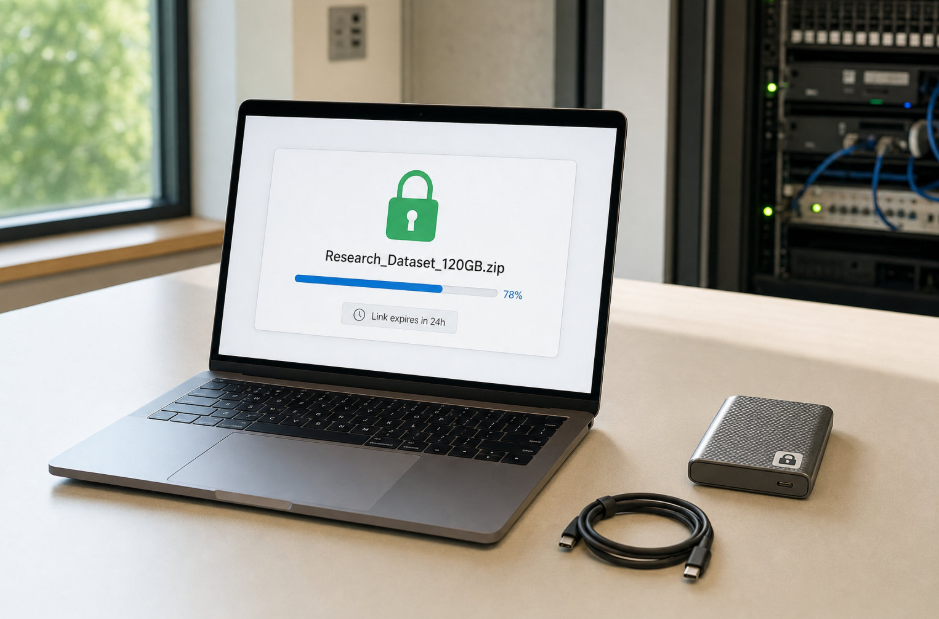
Institutions can implement authenticated access, least-privilege permissions, and time-limited links to help ensure only designated recipients can access files for a specific period. File integrity checks help protect against corruption or tampering, while systems that log user activity facilitate access tracking.
Data types requiring careful handling in academia
Large academic files often include regulated or sensitive data, necessitating careful handling. Student records, such as grades, transcripts, and demographic information, are subject to privacy controls and must not be inadvertently exposed.
Health research data, proprietary findings from industry partners, and information from human subjects can carry significant risks if disclosed. Faculty and staff should understand which information is subject to regulatory protection to select suitable security measures when transferring files.
Practical controls for effective data security
Security can be improved by using approved institutional platforms designed for large-file transfers. Strong passwords, multifactor authentication, and role-based sharing help lower the risk of unauthorized access and limit the distribution of sensitive materials.
Avoiding publicly accessible links and confirming recipient details helps guard against phishing and credential theft. Using link expiry features further reduces the likelihood of security incidents.
Institutional policies and compliance requirements
Universities often classify data by sensitivity and enforce corresponding policies for handling, storing, and transferring each category. Clear audit trails and retention policies help manage data throughout its lifecycle and support accountability in file exchanges.
Assessing third-party services and establishing incident response protocols can help minimize legal and reputational risks. Staff and researchers should follow institutional policy to maintain compliance standards when working with large files.
Operational enhancements for information technology teams
IT departments are key in setting up standardized procedures for secure file transfers. Providing user training on risks and updating guidance helps ensure alignment with established protocols university-wide.
Centralized logging and integration with identity management systems support monitoring and enable timely responses to suspicious activity. These practices foster both secure data exchange and academic collaboration across campus.